
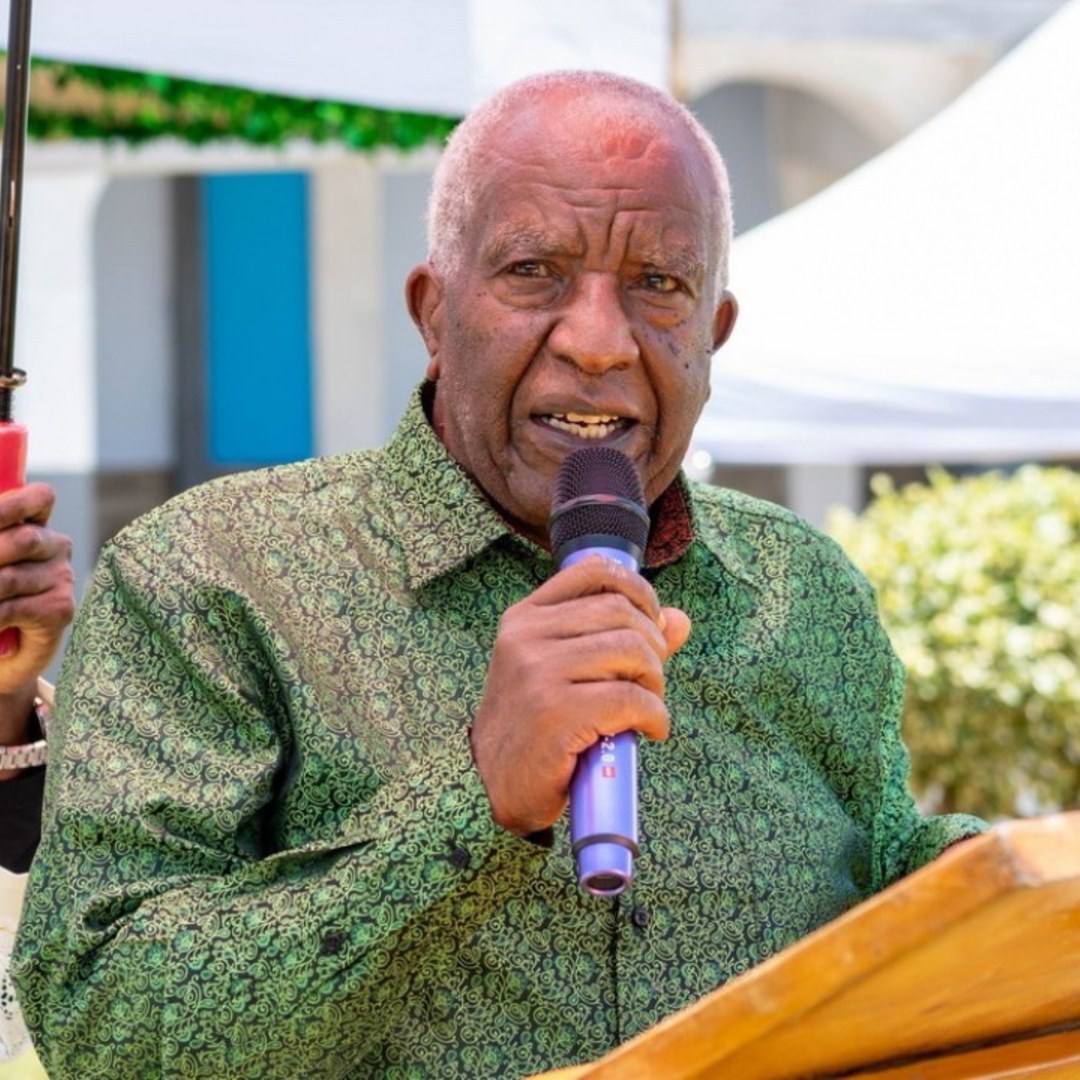
Many know him as a magnate, a shrewd entrepreneur, and, in whispers, a billionaire. Few know the story that preceded his fame and fortune. Few know the man, his faith, his education, and the quiet resilience that shaped his rise. Even fewer understand the depth of his philanthropy and his unwavering fidelity to the charism of the Consolata Missionaries.
He is the fruit of their evangelizing work. And today, as a sign of gratitude, he is giving back to them what, through a Consolata missionary in Tuthu, radically changed his life.
During the centenary celebration of the birth of Saint Joseph Allamano , held at the Consolata Shrine in Westlands on February 28, 2026, Dr. Peter Kahara Munga, founder of Equity Group Holdings, shared a piece of writing for the occasion. He spoke not as a tycoon, but as someone grateful for what he received from the missionaries.
Pilgrims walk the streets of the village of Tuthu, the first Consolata Missionary mission. It was here that young Peter Munga received his five-shilling scholarship from Father Cremasco.
"Today I stand before you not as a businessman, nor as a leader, nor as a public figure. I come as a grateful son of the Church, who has benefited from the self-sacrifice and fidelity of missionaries, the fruit of a lived faith and a living witness that, planted in fertile soil, bears fruit beyond all imagination," reads a passage from the address.
A childhood interrupted and redirected by Providence
Born on August 28, 1943, in the village of Nyagatugu, on the slopes of Aberdare in Murang'a County, Peter Kahara Munga's early life was marked by deprivation. His father, Benson Kahara, worked as a domestic worker; his mother, Beth Nyambura, was a farmer and casual laborer. Like many boys of his generation, he herded animals that didn't even belong to his family.
His education was challenging from the start. He began at Nyagatugu Primary School before transferring to St. Peter Clavers School in Nairobi, after his father ventured into a small business in Gikomba. But the declaration of a State of Emergency during the Mau Mau uprising changed everything. His father was detained. His mother was displaced. Young Munga was forced to drop out of school.
The Consolata Missionaries arrived in Kenya in 1902, founding their first mission at Tuthu, Murang'a County.
Years later, he described that period simply: "This was the heavy price of freedom." He returned to Nyagatugu with virtually nothing. His future seemed compromised, until what he now calls a decisive intervention of grace arrived.
The five shillings that changed a nation
In 1955, in Tuthu, a Consolata missionary priest, Father Aldo Cremasco, offered him a scholarship of five shillings.
"Five shillings," Dr. Munga recalled in his speech. "Today, that sum may seem insignificant. But back then, for me and my family, it was a blessing. It wasn't just money; it was hope. It was trust. It was the belief that a boy from a small village deserved a second chance at life."
That small grant allowed him to continue his studies at Kiangunyi and then at Gaichanjiru Secondary School, where another Consolata missionary, Father Vittorio Deleidi, was instrumental in shaping his moral and spiritual foundations.
"They didn't just teach us how to read and do math," he said. "They built our character. They instilled discipline. They taught integrity and humility. Above all, they helped us root our lives in faith."
Without that intervention, he frankly acknowledged, his life would likely have taken a different direction.
The Tuthu Mission in Kenya. Photo: Jaime C. Patias
Training before luck
Dr. Munga's academic journey was neither linear nor easy. After earning his Cambridge School Certificate and A Levels in the 1960s, he joined the Provincial Government, beginning a steady rise in public service. He went on to study public administration, human resources management, financial management, and public finance, and received a postgraduate degree from Harvard.
In 1980, he was already Undersecretary at the Ministry of Agriculture, where he initiated the computerization of the budget. He later served as Deputy Secretary at the Ministry of Tourism and as a director of several state-owned companies.
In 1984, he founded the Equity Building Society in Kangema with an initial capital of 5,000 Kenyan shillings and five employees. From that initiative, what he calls "capitalism with a human face" was born.
Equity grew to become one of East Africa's largest banks by client base, listing on the Nairobi Stock Exchange in 2006. However, in his reflection, Dr. Munga attributed that success not to managerial genius, but to the missionary training he received.
“It was that scholarship I received from Father Aldo Cremasco that later inspired me to create the Wings to Fly program at Equity Bank, so that thousands of other children, like that little boy from Tuthu, could have the opportunity to dream beyond their sometimes adverse circumstances,” he writes.
The logic is clear: what was done for him, he multiplied for a nation.
The Apostolic Nuncio to Kenya, Archbishop Bert van Megen, with the bishops and missionaries of Consolat. Photo: Paschal Norbert
Industrialist, educator, philanthropist
In addition to banking, Dr. Munga has invested in agribusiness through Equatorial Nut Processors and cotton processing through Meru Ginneries, creating jobs and strengthening agricultural supply chains. He has also been involved in energy infrastructure with Greystone Industries, producing concrete poles to modernize rural electrification.
His commitment to education extends through the Pioneer Group of Schools and Pioneer International University. In 2011, he founded the Peter Munga Foundation to fight hunger and poverty through sustainable agriculture and entrepreneurship.
The University of Nairobi recognized this transformative impact in 2016 by awarding him the degree of Doctor of Letters (Honoris Causa), citing his lasting contribution to philanthropy and national development.
A son of the Consolata
But on February 28, titles didn't matter, only the spiritual legacy. Dr. Munga spoke of the Consolata charism as a "forest of faith" planted in Kenya after the missionaries' providential departure from Ethiopia.
“The seed planted in Tuthu, Kenya, has grown into a forest from which faith flourishes and thrives,” he reflected.
Celebration of the centenary of the birth into heaven of Saint Joseph Allamano at the Consolata Shrine in Nairobi
He recalled being in St. Peter's Square in October 2024 during the canonization of St. Joseph Allamano, an experience that touched him deeply.
He listed leaders who had been trained in the Consolata orbit—bishops, public officials, jurists, and statesmen—underscoring that the missionary investment in education and character has had generational consequences for the Church and the country.
He argues that from this missionary formation emerged men and women who would later shape the nation's moral and civic architecture: President Mwai Kibaki; Professor Wangari Maathai; Ambassador Francis Muthaura; John Michuki; Ambassador Emma Murai; Senior Advisor Fred Ngatia, who later drafted the Constitution of the Sant'Allamano Foundation; Jane Michuki; Justice Gachoka, along with many others from different generations whose leadership bears the imprint of the Consolata spirit.
To preserve and expand this legacy, the San Giuseppe Allamano Foundation was inaugurated, with the mission of deepening evangelization and integral human development.
“If five shillings could change a life, imagine what shared faith and responsible management can do today,” he said.
The logic of gratitude
The life story of Dr. Peter Kahara Munga is often told in economic terms: market capitalization, branch networks, industrial capacity. But at the Consolata Shrine, another reality emerged: loyalty.
Faithfulness to the faith rooted in him; Faithfulness to the discipline instilled by the missionaries; Faithfulness to the principle that life's opportunities should be offered to all, not denied.
Celebration of the centenary of the birth into heaven of Saint Joseph Allamano, Consolata Shrine in Nairobi. Photo: Francisco Martínez
With visible humility he concluded:
«Personally, I remain forever grateful: grateful to Father Aldo Cremasco, grateful to Father Vittorio Ugo Deleidi, grateful to the Consolata missionaries, and grateful to God for the life and vision of Saint Giuseppe Allamano.
May this forest of faith continue to grow and new seeds be planted. May future generations look back and say that we have been faithful stewards.
The boy from Nyagatugu who once depended on five shillings now leads institutions worth billions. Yet, in his own account, the wealth that shaped his life was never financial, but faith.
That faith, planted by the missionaries in Tuthu, continues to bear fruit beyond imagination.
Paschal Norbert, journalist and director of CISA News , Kenya